admin
admin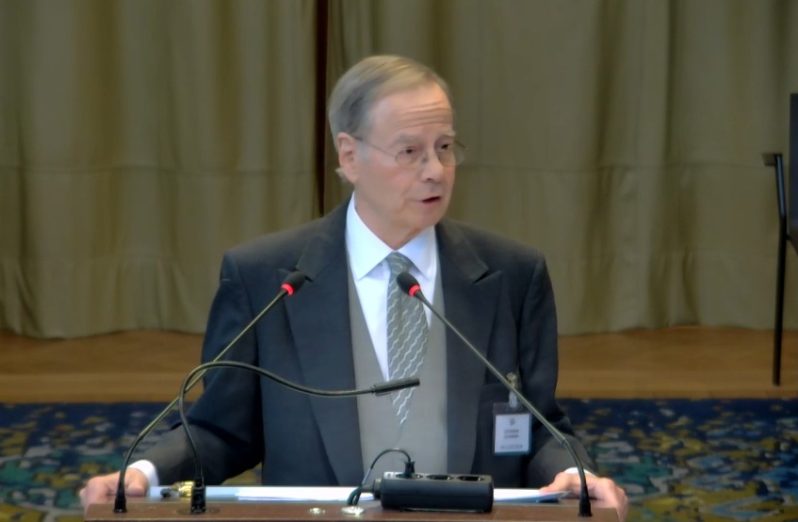
Guyana’s legal team on Monday mounted a detailed and forceful defence of its case before the International Court of Justice (ICJ), rejecting Venezuela’s jurisdictional objections and reaffirming the legal validity of the 1899 Arbitral Award during oral hearings in Guyana v. Venezuela.
Leading the rebuttal on jurisdiction, Professor Pierre d’Argent told the court that Venezuela’s continued challenges to the court’s authority reflect a “misreading” of the 1966 Geneva Agreement and ignore prior rulings which have already settled the issue.
Professor d’Argent argued that the Court’s jurisdiction has been conclusively affirmed, pointing to its December 2020 judgement and April 2023 ruling, both of which rejected Venezuela’s objections and cleared the way for the current hearings on the merits.
“Venezuela should not be allowed to revisit issues already decided by this Court,” d’Argent stated, emphasising that the case has progressed to evaluating the validity of the 1899 Award and the boundary it set.
Also representing Guyana is renowned international lawyer, Paul Reichler, who delivered a rigorous and historically comprehensive defence of the 1897 Treaty of Washington, the legal foundation for the arbitration that produced the 1899 Arbitral Award.
Reichler told the court that Venezuela’s attempt to invalidate the Award by attacking the 1897 treaty is “entirely without basis”, both in law and fact.
Reichler outlined that Venezuela not only ratified the treaty in 1897 but also accepted and complied with the resulting Arbitral Award for more than 60 years before raising any formal objection in 1962.
“The challenge comes not just decades, but generations too, late,” he said.
Addressing Venezuela’s claim that the treaty was negotiated “behind its back”, Reichler presented extensive historical records showing that Venezuelan representatives were directly involved in the negotiations and actively shaped key provisions, including those related to territorial claims and legal principles.
“The documentary evidence completely refutes any suggestion of exclusion or collusion,” he argued, noting that Venezuela itself expressed satisfaction with the treaty at the time and moved swiftly to ratify it.
Reichler also dismissed claims that Venezuela was misled or acted in error, pointing out that its government, legal advisers, and Congress all reviewed and approved the treaty, with officials describing it as fair and beneficial to the country.
On the issue of arbitration, he said Venezuela’s assertion that it was denied representation on the tribunal was contradicted by evidence showing it negotiated and secured a role in appointing arbitrators, ultimately choosing distinguished jurists aligned with its interests.
He further rejected arguments that the treaty was signed under coercion, stating that international law at the time did not recognise coercion as grounds for invalidating treaties and that, in any case, no evidence of coercion exists.
“To the contrary, Venezuela had long sought arbitration and welcomed the agreement when it was achieved,” Reichler told the court.
He added that Venezuela’s current argument of “structural coercion” is inconsistent with its historical position, including repeated appeals to the United States to help secure arbitration with Great Britain.
Reichler concluded that there is “no legitimate basis whatsoever” to invalidate either the 1897 Treaty or the 1899 Arbitral Award, maintaining that the boundary established over a century ago remains legally binding.
The presentations form part of Guyana’s case as the ICJ considers the long-standing controversy over the Essequibo region, with a final ruling expected to determine the validity of the Award and the legal boundary between Guyana and Venezuela.
(DEPARTMENT OF PUBLIC INFORMATION PRESS RELEASE)