


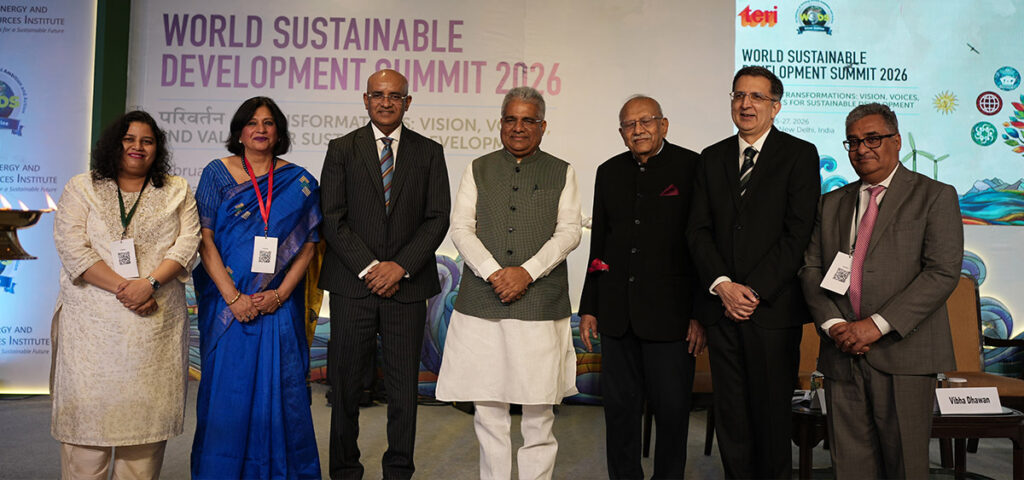
Vice President Dr. Bharrat Jagdeo issued a call for the Global South to focus on national self-reliance and modern technology to navigate a changing global landscape.
The VP was at the time delivering the inaugural address at the 2026 World Sustainable Development Summit (WSDS) at the Taj Palace, New Delhi, India.
The global summit, hosted annually by The Energy and Resources Institute (TERI), is one of the world’s leading platforms for dialogue on climate action, sustainability, and green development.
The event brings together heads of government, policymakers, scientists, private sector leaders, and civil society representatives to advance solutions to global environmental challenges.
Dr Jagdeo pointed to Guyana’s own success in monetising its natural resources as a template for the Global South. The country’s primary forests are treated as a high-value product and as such has secured massive investments.
The VP noted that Guyana successfully sold 30 per cent of its forest carbon for $750 million under the ART TREES (Architecture for REDD+ Transactions), suggesting that if such a model were extrapolated to the nation’s entire forest, it would be worth nearly $3 billion.
“All of these things can be done at the national level. We’re going to be producing about 1.5 to 2 million barrels of oil within the next three years per day. We want to prove that you can do that and still have a sustainable strategy within the country,” he told the Summit.
Further, recognising the emerging role of Artificial Intelligence in sustainable development, VP Jagdeo stressed that the world can no longer rely on traditional approaches to these modern issues.
While acknowledging that AI consumes vast amounts of energy, he framed it as an essential tool for the Global South to bypass traditional development hurdles. Dr Jagdeo expressed concern over a growing technological divide that could leave smaller nations in Africa, the Caribbean, and the Pacific behind.
“We need to build awareness among technical people like how TERI helped to build awareness for 25 years around climate issues. We have to help to build awareness around AI and its impact on development,” he said. “We have to build a template how AI could, for example, use satellite technology they can map every tree in my forest and tell me the species. So I don’t need any longer to send people in the forest. We can track it. You can have world-class MRV systems that are cheaper for countries like ours.”
He called for the creation of templates that help smaller countries organize their AI efforts, specifically in sectors like healthcare and education.
“We now need to add an AI variable to national planning, because countries might spend 120 million U.S. dollars on building a road, and they’re very comfortable with that. But 20 million spent on introducing AI in the education sector or health care may have a bigger impact on that road that you build, the physical road. But if we use old thinking, then we build a road,” the vice president explained.