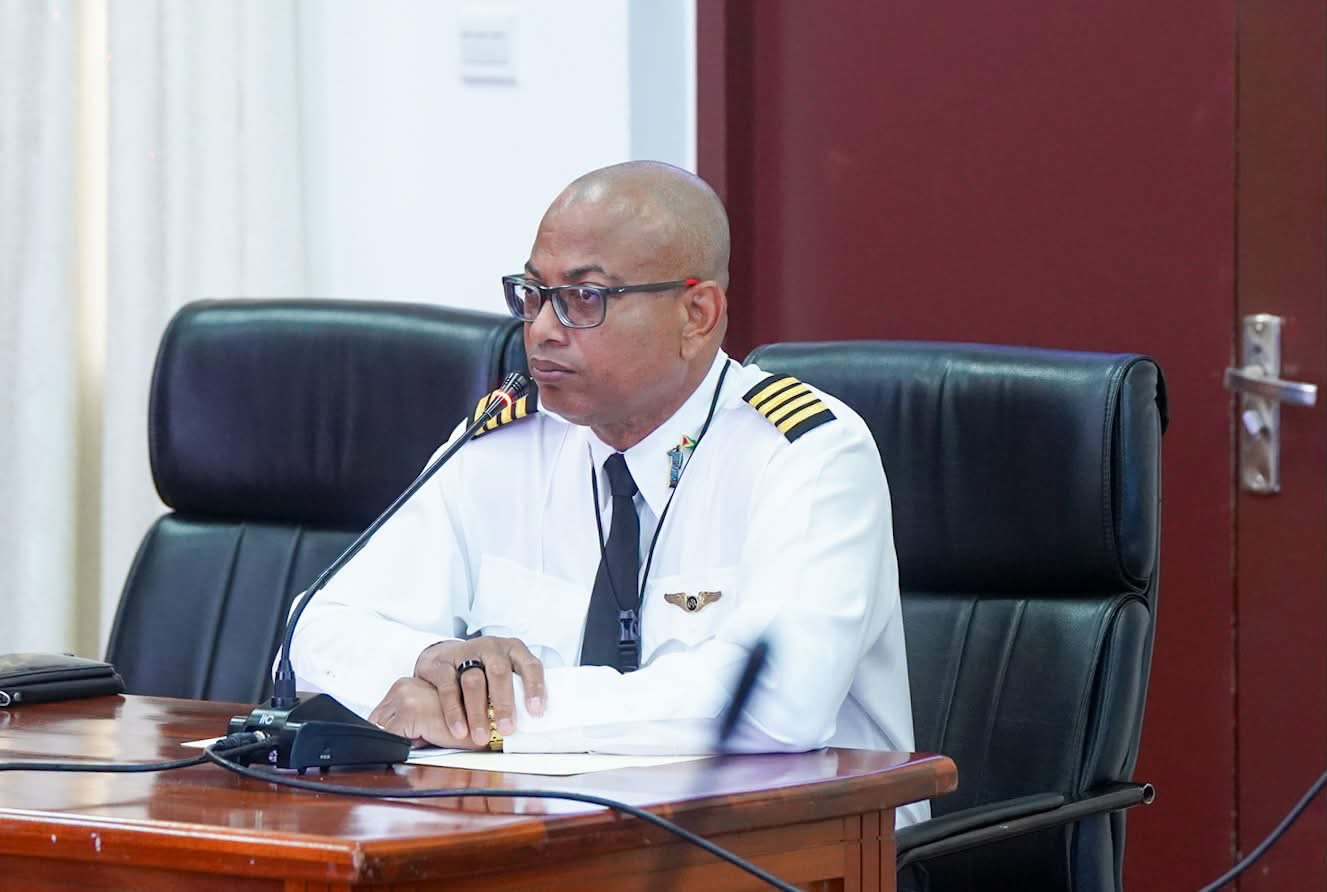
Ten survivors of the MV Barima were rescued within minutes of Roraima Airways pilot Captain Learie Barclay pinpointing the location where the vessel had sunk and relaying the coordinates to authorities, the Presidential Commission of Inquiry heard on Thursday.
Following an emergency signal and three distress flares, Barclay and his crew identified the location at 2:09 am on July 19. On their return flight to Eugene F. Correia International Airport, Barclay received word that two survivors were rescued, followed shortly afterwards by another eight. Capt.
Barclay said his aircraft landed at 2:37 am, almost exactly an hour after it had taken off in an effort to identify the source of a distress signal. He headed first to Hampton Court and from there out to sea.
He testified that he saw a bright flare against the pitch-black sea and switched to a distress frequency. He kept following the signal when he saw two additional flares.
“We were looking for a ferry, a reasonably sized boat. Unfortunately, we saw nothing of consequence below us,” Barclay told the Commission.
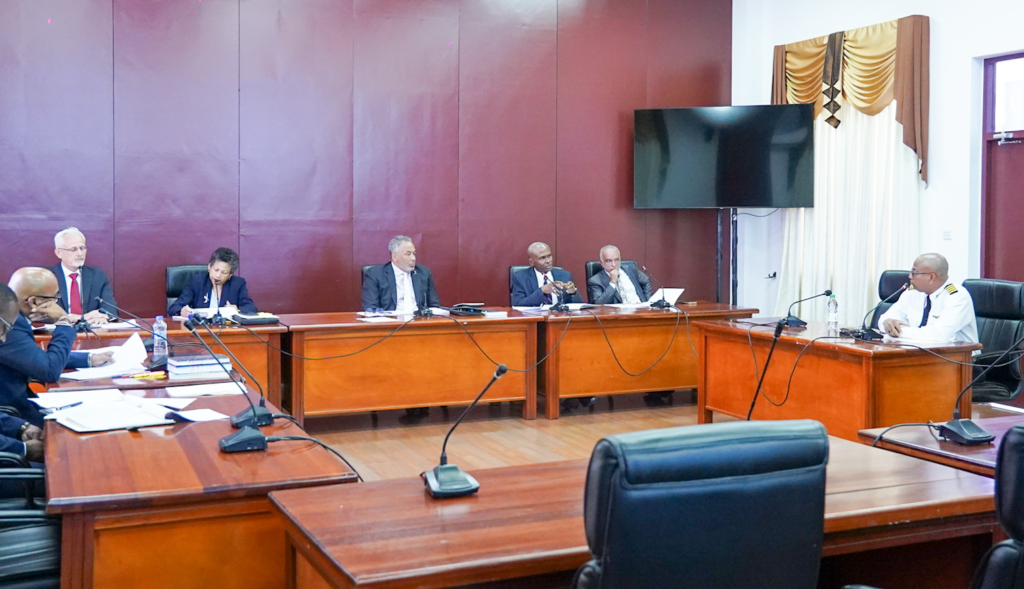
Roraima Airways’ Director of Operations and a commercial pilot with 26 years’ experience, Barclay gave his account during the second day of public hearings at the Arthur Chung Conference Centre. He was the fourth witness to appear before the five-member Commission investigating the MV Barima tragedy.
“I think there was a bit of luck involved there that we got it just right on the first line. Because you could be flying back and forth in a grid before you get to it,” he said.
Barclay testified that the emergency response began for him at 12:16 am, when Captain Gerry Goveia Sr called him to report that the MV Barima was believed to be in distress and requested help with an aerial search.
“After I got the call, I got out of bed, dragged on a flight suit, woke my wife up, informed her that I was leaving, that there was an emergency I needed to take care of, and drove to Ogle,” he said.
He arrived at the airport at 12:45 am and began preparing a yellow, black and white Islander aircraft, which had a little over two and a half hours of fuel on board.

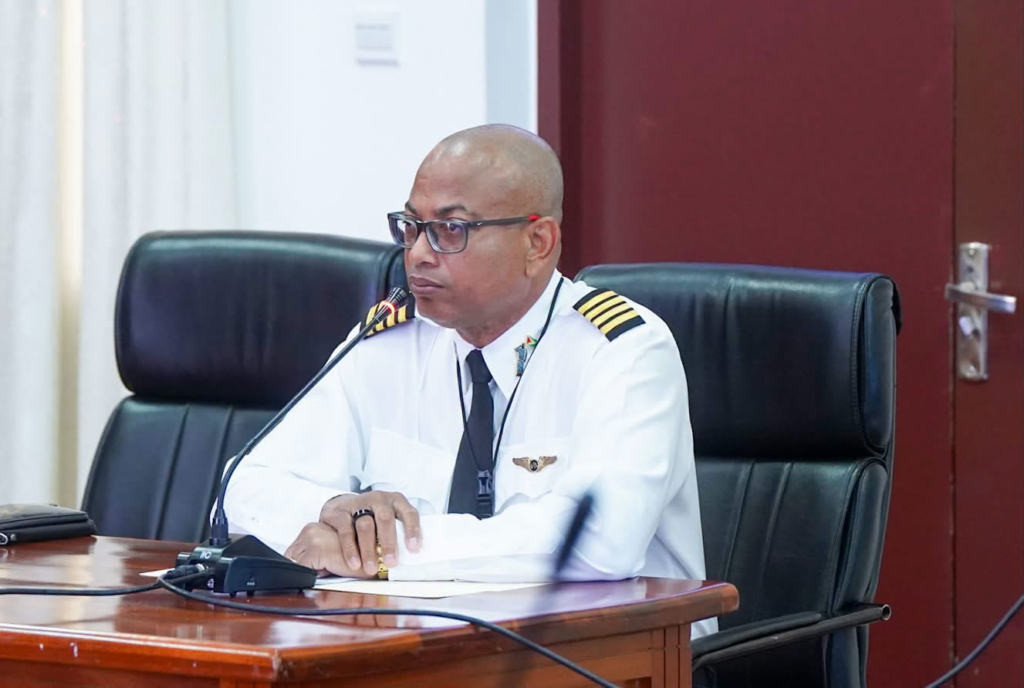
Roraima Airways pilot Captain Learie Barclay
Captain Goveia Sr. sent him the coordinates for the reported distress location, which had come from the Aeronautical Information Centre. Barclay entered them into his Garmin Pilot navigation software, which placed the location over water near Hampton Court in Region Two.
He then went to the Guyana Defence Force Air Corps Hangar, where Lieutenant Colonel Anson Weekes had just arrived, and confirmed that they had the same coordinates.
“So, at that point, I was confident that I was going to the right place,” he said.
Captain Gerry Goveia Jr arrived at about 1:20 am for a crew briefing. Barclay assigned him to fly the aircraft while he handled navigation and communication with air traffic control. A third crew member sat in the back as a spotter.
The aircraft departed at 1:36 am.
Once airborne, Barclay sought information about the tide to help determine where the search should proceed.

“The first question I ask is, where is the tide going? The reason I ask that question is, if something is floating on the surface, the tide will push it,” he explained.
Air traffic control told him it was low tide and that the water would be moving outward.
The crew reached the search area at about 1:56 am. After a brief sighting they could not confirm, they headed farther out to sea, following the direction in which they understood the tide would carry anything floating.
Barclay tuned the aircraft’s radio to 121.5 MHz, the international distress frequency, and immediately picked up a strong emergency locator transmitter signal.
“So, we continued on that line because the signal kept getting stronger and stronger,” he said.
The crew then saw a flare, followed by a second and a third. At 2:09 am, Barclay marked the location and reported it to air traffic control.
Questioned by counsel, he confirmed that the crew had seen flares, not the vessel itself. He described flares as a standard part of survival gear and “an international symbol of distress.”
“We expressed concern in the cockpit. Grave concern. Because the flares were very bright, but we saw nothing of consequence on the sea,” he said.
The aircraft climbed so that air traffic control could fix its position on radar. Barclay also sent the coordinates by WhatsApp to Lieutenant Colonel Weekes, who, he said, was on his way to Hampton Court with a drone team.
“We flew overhead for another probably five minutes, but it’s pitch black. There’s nothing we could see. So, we realised that we had done all we could do at that point,” he said.
On the return flight, Barclay was told that the first two people had been rescued. Shortly before landing, he heard that another eight had been rescued.
The aircraft landed at about 2:37 am. Barclay said he then briefed President Dr Mohamed Irfaan Ali on what the crew had seen.
A former Guyana Defence Force pilot, Barclay also reflected on his commitment to national service. He told the Commission that he could not have afforded to become a pilot without the support of the people of Guyana and regarded his work as service to the nation.
The public hearings continue at the Arthur Chung Conference Centre.