


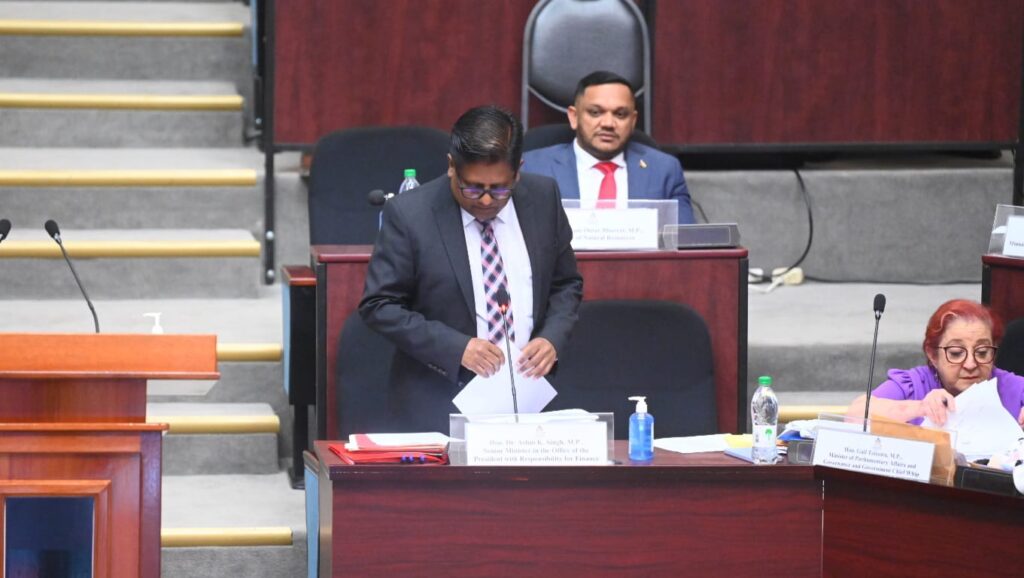
The People’s Progressive Party/Civic (PPP/C) Government continues to manage Guyana’s public debt with prudence and discipline, maintaining a track record that is widely regarded as among the strongest in the region. Through careful borrowing aligned with national development priorities, sustainable debt-to-GDP ratios, and a deliberate focus on concessional and development-oriented financing, the Government has preserved the country’s fiscal stability and creditworthiness even as it accelerates transformative investment in infrastructure and public services. The agreements outlined below reflect this measured and responsible approach: each loan has been contracted on favourable terms, directed toward high-impact projects, and structured to deliver lasting value for the Guyanese people while safeguarding the nation’s long-term financial health.
- New investment to deliver safer, climate-resilient roads across the country
The Government and World Bank Signed an equivalent US$156 Million Financing Agreement for the Integrated Transport Corridors Project
The Government and the International Development Association (IDA), part of the World Bank Group, signed a financing agreement to support the Integrated Transport Corridors Project, a landmark investment in safer, more climate-resilient road infrastructure. The agreement was signed on October 14, 2025.
Guyana’s Integrated Transport Corridors Project is designed to deliver safer, more climate-resilient roads while strengthening the country’s capacity to respond to crises. It advances along two complementary fronts. The first centres on physical road improvements, including the rehabilitation and upgrading of key corridors, enhanced drainage and slope stabilisation, crash barriers and traffic-calming measures.
The second front focuses on strengthening institutional capacity for road sector management. This encompasses a national road safety diagnostic, assessments of speed limits and mobility patterns, and community mobility plans developed with a strong emphasis on women’s needs and climate resilience, alongside a targeted road safety Programme for schools, markets, hospitals, and other locations with high concentrations of vulnerable road users. The project further supports road asset management and inclusive capacity building, including a certified training Programme for local engineers and initiatives to expand women’s employment and entrepreneurship across the road construction sector.
Reflecting the Government’s prudent approach to risk, the agreement also incorporates a Climate Resilient Debt Clause, allowing for the deferral of payments during declared national emergencies, and a Rapid Response Option that enables the swift mobilisation of funds in times of crisis.
The Integrated Transport Corridors Project highlights the enduring partnership between the Government of Guyana and the World Bank Group in advancing sustainable, inclusive, and resilient development nationwide.
- Agreements to Strengthen Climate-Resilient Water Infrastructure
The Government and Inter-American Development Bank (IDB) signed a US$30 million credit line and US$15.57 million first loan to expand and modernise water services
The Government and the IDB signed two agreements to advance climate-resilient and sustainable water and sanitation services across the country. Both agreements were signed in Georgetown on November 14, 2025.
The first agreement establishes a Conditional Credit Line for Investment Projects (CCLIP) for Water and Sanitation Improvement in Guyana, with a total envelope of US$30 million. The credit line provides a flexible framework for financing a series of individual water and sanitation operations over time. Its objective is to enhance climate resilience and the environmental and financial sustainability of Guyana Water Incorporated’s (GWI) potable water and sewerage services.
The second agreement is the first individual loan drawn under that credit line: a US$15.57 million facility financing the Guyana Climate Resilient Water Infrastructure Improvement Programme.
The programme is built around three core components. The first finances new climate-resilient infrastructure to expand the potable water supply for the rapidly growing population of the Diamond area in Region 4, comprising a new conventional water treatment plant, a surface water intake and raw water conveyance from the East Demerara Water Conservancy, approximately 15 kilometres of transmission mains, and a 0.6 MW grid-connected solar photovoltaic plant to power the new facility. The second component targets a substantial reduction in Non-Revenue Water across the East Bank Demerara, East Coast Demerara, and Cummings Lodge systems in Georgetown through the installation of 40,000 ultrasonic smart meters, advanced leak and pressure management, and public conservation campaigns. The third strengthens GWI’s commercial, operational, and financial management capacity through digital transformation, cybersecurity, modernised management information systems, and a gender and Persons with Disabilities action plan to promote diversity and inclusion within the utility.
Together, these agreements underscore the enduring partnership between the Government of Guyana and IDB in delivering reliable, modern, and climate-resilient water services, expanding access for growing communities, and reducing water losses.
In addition to the agreements outlined above, amendments to three existing financing arrangements were also tabled in Parliament. These comprised the Export–Import Bank of the United States facility financing the Guyana Gas-to-Energy Project; IDB Loan Contract No. 4676/BL-GY, Amendatory Contract No. 1, which supports the Strengthening Energy Matrix Diversification Programme; and the CARICOM Development Fund Agreement financing the Agricultural and Infrastructural Development Programme.
As the Government continues to catapult development across every sector, it is noteworthy that Guyana’s debt position has undergone a remarkable transformation over the past three decades, evolving from one of the world’s most heavily indebted nations into a country distinguished by fiscal strength and long-term sustainability. Public and Publicly Guaranteed (PPG) debt as a share of GDP has fallen substantially, from over 600 percent in 1991 to just 28.6 percent at the close of 2025. Equally striking, the debt-service burden has eased from a once-crippling 90 percent of Government revenues to a comfortably manageable 5.5 percent, freeing resources for investment in infrastructure, health, education, and other national priorities.
This progress has not gone unnoticed: in its 2025 Article IV Report, the International Monetary Fund assessed Guyana as being at low risk of debt distress and with low vulnerability to large shocks, a clear endorsement of the PPP/C Government’s unwavering commitment to fiscal discipline, prudent debt management, and strategic economic planning.