admin
admin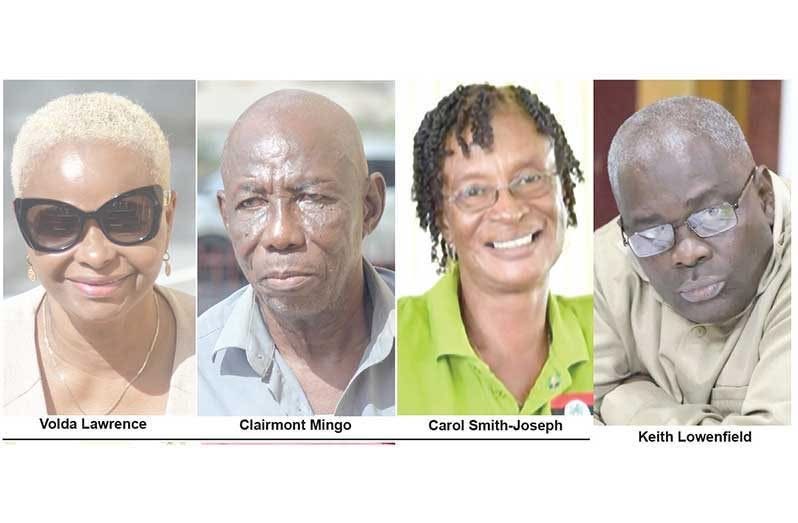
A signature that drew public questions when Guyana’s disputed Region Four election declaration appeared online in March 2020 was back at the centre of the courtroom on Wednesday.
Police handwriting expert Ameer Mohamed stood by his opinion that signatures bearing Volda Lawrence’s name on passport applications and the disputed declaration were written by the same person, despite a sustained challenge from defence attorney Nigel Hughes.
The Form 24 at issue was associated with the March 5, 2020 declaration by Region Four Returning Officer Clairmont Mingo. When GECOM published it, a signature appearing to be Lawrence’s was visible below Mingo’s. Lawrence, then an APNU+AFC counting agent, later denied wrongdoing, calling the allegations against her “trumped-up charges.”
The document’s significance extends beyond the signature. Mingo’s March 5 declaration recorded 136,458 Region Four votes for APNU+AFC and 77,329 for the PPP/C. Forensic accountant Terrence Jaskaran has since testified in this trial that, compared with his tally of certified Statements of Poll, the declaration showed 20,243 more votes for APNU+AFC and 2,959 fewer for the PPP/C. Those are findings from his numerical comparison, not findings by the court about who caused the discrepancies.
Mohamed told Principal Magistrate Faith McGusty that he compared the signature on the Form 24 with signatures on passport applications from 2010, 2015 and 2020. His conclusion was that the signatures he examined had a common author. While that handwriting opinion does not, by itself, prove that Lawrence signed the declaration, the prosecution intends to establish the link through the evidence before the court.
Hughes questioned Mohamed about handwriting features, including hooks and loops, and pressed him to show where particular observations appeared on his comparison chart. When asked about a “hook” that was not specifically marked on the chart, Mohamed maintained that it could be seen in the letter “V”.
The sharpest exchange came when Hughes pointed to markings over the Form 24 signatures that were absent from the 2010 passport-application signature. Mohamed acknowledged the difference but treated it as “natural variations”, not a reason to abandon his conclusion.
Pressed on whether he had specifically recorded those markings in his report, he said they were covered by his general observations. In another exchange, he clarified an earlier answer about his initials on two documents after Hughes pointed out that “AM appeared in different positions on them.
The defense failed to get Mohamed to admit a flaw in his analysis. The court has accepted him, a member of the Guyana Police Force’s Fingerprint and Handwriting Analysis Unit, as an expert in handwriting analysis.
His testimony on Tuesday concerned signatures bearing the names of former Chief Election Officer Keith Lowenfield and accused Carol Smith-Joseph on other election documents in the case.
Wednesday’s hearing also included evidence about the handling of documents supplied to Mohamed.
Lawrence and eight other co-accused have pleaded not guilty. Proceedings will resume on October 19, 2026.
By day’s end, the defence had placed Mohamed’s methodology under an unforgiving microscope; yet the expert refused to retreat from the opinion on which the prosecution’s handwriting evidence rests.