


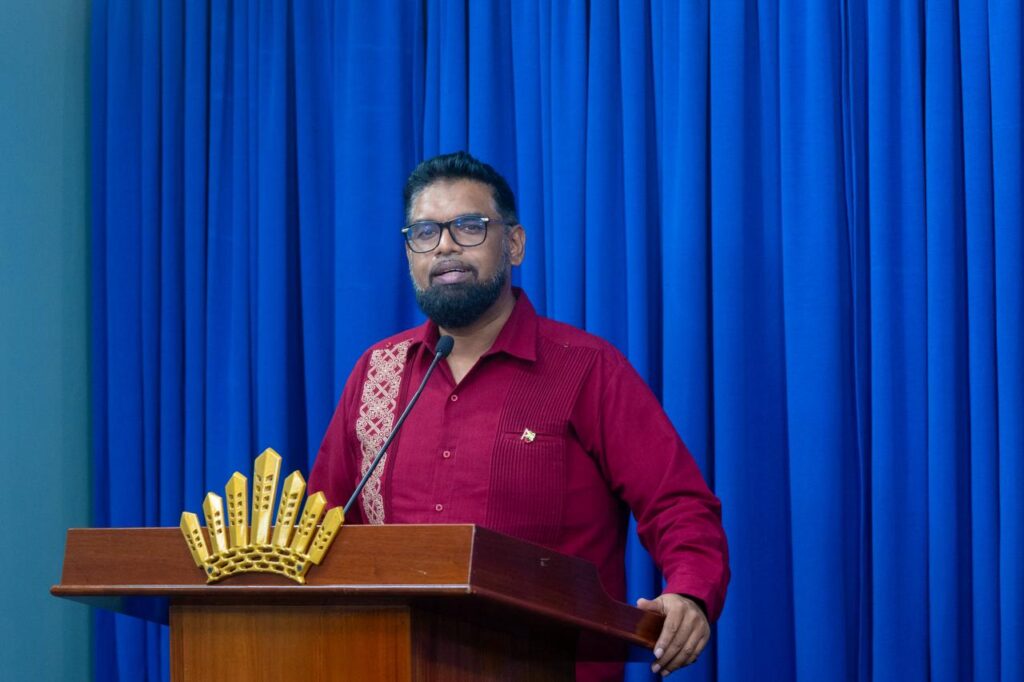
President Dr. Mohamed Irfaan Ali says Guyana is moving towards an AI-driven national security system that will use predictive policing, facial recognition, smart surveillance and integrated command centers to strengthen crime prevention and public safety by 2030.
During a press conference at the Office of the President on Friday, the President explained that the system would connect all security agencies through a common interface designed to improve interoperability and data-sharing while supporting regional and international security cooperation.
According to President Ali, the architecture will rely heavily on digitisation, including digital passports, digital identification cards and integrated information-sharing systems.
“Such system must be in compliance with global standards and integrated in supporting the security not only of Guyana, but our region and with our allies. Technology, intelligence, governance, resilience, community, civil society, are all critically and will be critically integrated into the system,” he explained.
Among the measures announced are smart police stations capable of operating around the clock, AI-powered policing systems, online crime reporting services, mobile policing applications and real-time command centers already being rolled out in several regions.
“These command centers are, while regionally decentralized, are also centralized at a national level. It is a common shared platform with different tiers of information set, depending on needs and depending on the agencies,” he said.
Artificial intelligence is expected to play a major role in predictive policing and crime prevention. President Ali said AI systems will assist with facial recognition, behavioral analytics, automated threat detection and surveillance management to improve law enforcement response times and investigative capabilities.
“This will allow us, in real time, to predict patterns, networks. It will help us to monitor public spaces and spaces of interest, improve emergency response, and enhance our border security,” the President stated.
He further explained that the technology would allow authorities to monitor major events and high-risk locations more effectively through advanced surveillance systems capable of identifying threats and suspicious behaviour in real time.
“This technology would allow us, with the use of one vehicle, to be stationed there, to have full coverage of that entire area in a predictable manner, assessing threats, assessing behavior, and giving advanced information to officers,” he added.
The President also highlighted the expansion of smart traffic and surveillance technology already being deployed across the country. He said authorities have recorded significant reductions in speeding and traffic accidents in areas where smart cameras have been installed.
“As you know, we have launched the smart cameras, traffic cameras, and we have seen massive reduction in accidents and speeding in the areas that we have launched the cameras,” he said.
According to the President, AI systems are now capable of automatically identifying repeat traffic offenders within seconds and generating reports that can be integrated directly into the judicial system.
President Ali also revealed that government has already completed pilot testing of mobile AI-enabled surveillance units capable of detecting vehicles with outstanding traffic violations while moving along public roads.
“So the test a few nights ago on the East Coast alone found 250-plus vehicles with outstanding tickets just driving through, and no human can interfere with the system because the system would pick them up, document it on a screen, put it in a database, and then turn on even the traffic, the sirens to stop the vehicle,” he said.
The mobile units can also be stationed in fixed locations to provide full traffic monitoring coverage.
“It’ll have 360 degrees coverage of the traffic in that location to look at offenses,” the President noted, adding that the technology will soon be expanded nationwide.
The President noted that Guyana’s Safe Country initiative will continue expanding with plans for more than 25,000 cameras across approximately 6,700 sites nationwide by 2030.
“To date, I think we are closing in on 1,300 sites and about 6,000 cameras. We will be investing to have those 20,000 cameras installed by 2030 or long before, that 20,000 plus additional cameras. And those are just the static cameras,” he said.
President Ali also stressed that the broader objective is to create a people-centred security system that enhances public confidence while positioning Guyana within modern global security networks.